Cool Symbols From Naruto Symbols From Naruto Clip Art
| Sasuke Uchiha | |
|---|---|
| Naruto, Boruto: Naruto Next Generations character | |
 Sasuke Uchiha as seen in Part I (right), Part II (left), and the finale as well as the Boruto film and series (center) | |
| First appearance | Naruto affiliate three: Enter Sasuke! (1999) |
| Created by | Masashi Kishimoto |
| Voiced by | Japanese Noriaki Sugiyama English Yuri Lowenthal |
| In-universe information | |
| Notable relatives | Itachi Uchiha (blood brother, deceased) Sakura Uchiha (married woman) Sarada Uchiha (daughter) |
| Ninja rank | Genin in Role I |
| Ninja team | Team vii (Office I) Taka (Office Ii) |
Sasuke Uchiha (Japanese: うちは サスケ, Hepburn: Uchiha Sasuke ) () is a fictional grapheme in the Naruto manga and anime franchise created by Masashi Kishimoto. Sasuke belongs to the Uchiha clan, a notorious ninja family unit, and i of the almost powerful, allied with Konohagakure ( 木ノ葉隠れの里 , English version: "Subconscious Leaf Village"). Virtually of its members were massacred by Sasuke's older brother, Itachi Uchiha, earlier the series began, leaving Sasuke one of the few living. Despite condign compassionate toward his teammates Naruto Uzumaki and Sakura Haruno, Sasuke's feelings of powerlessness force him to carelessness his friends and his home in his quest to become stronger, and to find Orochimaru. Sasuke appears in several of the serial' animated feature films and related media, including video games, original video animations (OVAs), and Boruto: Naruto the Movie (2015) and its manga sequel, Boruto: Naruto Next Generations (2016), in which he is depicted equally a vigilante supporting his village and a mentor to Naruto's son Boruto Uzumaki.
Kishimoto conceived Sasuke as a rival of the serial' championship character Naruto Uzumaki. Despite Sasuke's dark character evolution later in the story, Kishimoto avoided portraying him as a villain; he found designing the character challenging and had difficulty creating a suitable look for him. Nonetheless, Kishimoto has grown to enjoy cartoon him. In the manga's blithe adaptations, Sasuke was voiced past Noriaki Sugiyama in Japanese and Yuri Lowenthal in English.
Sasuke's grapheme has received mixed responses from anime and manga publications. His impressive fighting skills, plot contribution, and rivalry with Naruto Uzumaki received some praise, but he was criticized equally a stereotypical rival in the mold of similar characters from other shōnen manga and as exhibiting a cold personality. Even so, Sasuke's characterization in latter parts of the story and more mature personality in the Boruto sequel earned further positive comments. Sasuke has besides placed highly in Naruto reader popularity polls and has also been the subject field of studies by scholars. Character-based merchandise, including activeness figures and central chains, has been released.
Creation
Evolution
Manga artist Masashi Kishimoto did not include Sasuke Uchiha in his original concept for the Naruto series, a story revolving around the grapheme Naruto Uzumaki. Discussing the series' future, his editor, Kosuke Yahagi, advised him to add together a rival grapheme for the protagonist Naruto and he created Sasuke.[one] The character'southward first name came from Sanpei Shirato'south manga Sasuke and Sarutobi Sasuke, a fictional ninja character in Japanese children's stories.[2] To introduce Sasuke, Kishimoto wrote a chapter that was set before the germination of his ninja squad, Team seven. The idea was scrapped; Yahagi told Kishimoto to focus the serial' first ii chapters on introducing Naruto instead and the focus on Sasuke and the rest of the supporting characters were shown in the next chapters for the first time.[3] [4] Once creating Sasuke's character, Kishimoto decided to apply him equally a protagonist rather than supporting character in club to start his evolution at the aforementioned time as Naruto.[5]
Kishimoto had read a variety of manga to obtain ideas for the creation of an constructive rivalry between two characters, which he incorporated into Naruto and Sasuke'south relationship. He was also inspired past his human relationship with his twin brother, Seishi Kishimoto; since childhood, Masashi had worried virtually Seishi when he faced failure and had tried to help him.[6] To contrast Sasuke with Naruto, Kishimoto made him less emotional and depicted him as a "cool genius"; he felt he had created an ideal rivalry in the pair,[7] and when i character progressed he ensured the other did as well.[8] Kishimoto wanted Naruto and Sasuke to seem similar brothers and rivals, edifice on a common feel of childhood loneliness. Although Sasuke does not regard Naruto equally a worthy opponent at outset, he is surprised by Naruto'due south growth and becomes fiercely competitive. In the Part I finale, their rivalry leads to a fight and they grow further autonomously. Kishimoto said he did not want Sasuke to recognize Naruto as an equal until later in Part II.[9]
Although both characters had used ninja techniques throughout the series, Kishimoto wanted the two fighters to rely on hand-to-hand combat for the climax of their final battle.[10] He decided to have Naruto forgive Sasuke because he had also forgiven Nagato, another sometime enemy.[11] The concluding fight betwixt Sasuke and Naruto was considered one of the biggest challenges always faced by the staff from Pierrot as it took an entire month to adapt information technology from the manga. Director Hiroyuki Yamashita elected himself in charge of the boxing which left nigh of the anime members relieved due to his feel. For the scenario, Pierrot received assistance from CyberConnect2, the video game development studio who had already adapted this boxing through the fighting game Naruto Shippuden: Ultimate Ninja Storm iv. In that location was a need to make every movement in the fight look realistic, giving Sasuke a scary look as well equally hair motility in order to express the idea of both fighters willing to do anything to kill each other, which confused some due to Naruto'due south wish to avert this fate. The last disharmonism between Sasuke's Chidori and Naruto's Rasengan moves involved references from other scenes of the serial to give the viewer a bigger emotional touch. The staff noted that following this fight, Sasuke's face became calmer despite his initial look, giving room to explore his redemption.[12]
Kishimoto found Sasuke a difficult graphic symbol to write, requiring considerable planning. In the series finale, Sasuke leaves on a solo journey; Kishimoto later on stated that in addition to atonement, Sasuke wants to observe the origin of the final antagonist, only this was not explained in the story.[6] He planned Sasuke and Sakura Haruno's romance early in Naruto 'southward production and decided that despite having a good relationship with his allies, Sasuke would remain a rogue ninja at the end of the series.[thirteen]
Kishimoto wished to further explore Sasuke'due south role in the series after Naruto 's finale. He wanted to explicate the connection between Sasuke and Sakura in the spin-off manga Naruto: The Seventh Hokage and the Scarlet Bound (2015), which focuses on their daughter, Sarada Uchiha. Despite their separation during Sasuke'southward mission, which draws him away from his village, the story explains the bond between the three characters. Kishimoto focused on the concluding scene of the Uchiha family, which he regards as the spin-off'south most important facet.[14] Because Sasuke had few appearances in the Naruto films, Kishimoto decided to give him a bigger function in Boruto: Naruto the Flick (2015), in which he teaches Naruto's firstborn kid, Boruto Uzumaki; a reference to Piccolo and Gohan in Akira Toriyama's Dragon Ball manga serial and as well depicted in the manga Boruto: Naruto Adjacent Generations (2016). Kishimoto identified Naruto's fights alongside Sasuke against Momoshiki equally the highlights of the film and asked that the moving-picture show's staff pay close attention to those sequences. 2 other scenes written past the staff which surprised Kishimoto were Sasuke's use of ane of his taijutsu moves and the combination of his Susanoo technique and Naruto'due south recreation of the Ix-Tailed Fox.[fifteen] [16]
Design
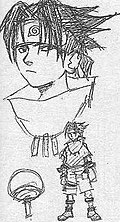

While early designs of Sasuke equally seen in Part I (left) were similar to the last one,[17] for Part Two (right) Kishimoto conceived multiple sketches which were scrapped.[eighteen]
Kishimoto regarded Sasuke as his virtually memorable character blueprint because he was developed equally Naruto's opposite.[19] He said the pattern of Sasuke and his Sharingan ( 写輪眼 , lit. "Copy Bike Eye", English manga: "Mirror Wheel Center") ability were influenced by the graphic symbol Hiei in Yoshihiro Togashi's manga series, YuYu Hakusho.[20] Sasuke originally had necklaces and ties around his arms and legs considering Kishimoto had a habit of giving characters as much ornamentation as possible; realizing he could non draw such a complex character on a weekly basis, Kishimoto simplified the design to a bones dissimilarity with Naruto's costume.[17] The Chidori ( 千鳥 , lit. "One Chiliad Birds") — i of Sasuke and Kakashi Hatake's best-known fighting techniques — originally had a unlike name that Kishimoto forgot. He found the name "Chidori" and its variant, the "Lightning Bract", advisable.[ix]
Kishimoto considered Sasuke his nearly challenging graphic symbol to pattern and draw. He lacked a clear thought of how his face should look, saying Sasuke seemed older than Naruto, his contemporary,[21] and felt this inconvenience was a effect of his inexperience in drawing characters who were mature beyond their years.[17] Sasuke'southward hair, originally short to save Kishimoto time, slowly grew longer as the series progressed.[21] Mid-way through Office I, he drew a new costume for Sasuke with belts strapped effectually his artillery and legs, simply he returned to the character's original design because it took less time to depict.[22] Sasuke is his favorite grapheme to describe despite the fourth dimension and free energy required,[17] and he compared Sasuke with Sakura in difficulty.[10] Kishimoto's superiors sometimes asked him to redraw parts of the manga that did not illustrate Sasuke well.[x]

Kishimoto's pattern focus for Part II was Sasuke'southward older appearance. Originally, Kishimoto had wanted to draw him every bit a more than attractive person, just the thought was discarded. An outfit he initially planned combined the younger Sasuke's outfit with new, more modern dress. Kishimoto tried several other looks, including the apply of Shimenawa to evoke the antagonist Orochimaru, and a turtleneck and armed services uniform to connote cleanliness. He avoided the 2nd option due to similarities with cold weather clothing and eventually chose Japanese clothing and a chokutō sword.[18]
For The Final: Naruto the Movie, Kishimoto gave Sasuke a new, young-adult design with sharper facial features.[23] In contrast with the older Naruto, who cutting his hair, Sasuke'due south hairstyle grew longer to embrace role of the graphic symbol's face up. In the original concept, the hair hid Sasuke's mysterious left eye — the Rinnegan ( 輪廻眼 , lit. "Saṃsāra Eye"). Co-ordinate to Kishimoto, he decided to requite the character a large hood because Sasuke curtained his identity during the events of the movie. Sasuke's blueprint was specifically created to support his actions; the area that showed Sasuke had lost his left arm in the Naruto finale was also covered by his wearing apparel.[24]
Personality and voice actors

Yuri Lowenthal, vocalisation of Sasuke in the anime's English-linguistic communication version
Sasuke is voiced past Noriaki Sugiyama in Japanese media. At the beginning of the anime'due south first function, Sugiyama had difficulty voicing Sasuke because he knew niggling about his personality; he began to sympathise the character at the bespeak in the story where Sasuke encounters his brother, Itachi Uchiha. Sugiyama read the manga and became peculiarly interested in Sasuke'southward development when the character left Konohagakure; he wanted to revoice some scenes from the anime, including Sasuke's departure from Konohagakure.[25] In Behind the Scenes of Uchiha, a feature nearly Sasuke and Itachi's backstory, Sugiyama said he had become emotional during the recording sessions of the sixth flavor of the anime'southward second function (Naruto: Shippuden), in which Sasuke learns the truth virtually his brother's function in the massacre of the Uchiha association.[26]
Sugiyama thought Sasuke's line, "You are annoying," summed up the grapheme's feelings toward Sakura and indicated a modify in their relationship each time it was said; although she initially annoys him, he smiles when he repeats information technology earlier leaving Konohagakure. Naruto'south Japanese voice extra, Junko Takeuchi, said Sasuke'southward line addressed to Sakura, "Encounter you adjacent time... Thank you," revealed his feelings for her. Sugiyama stated that by the finish of the series, Sasuke realized how much he had hurt Sakura'south feelings and apologized to her after his final fight against Naruto considering of this. While recording for Boruto: Naruto the Picture show, Sugiyama expected to see a bond between Sasuke and his apprentice, Boruto Uzumaki.[27] Co-ordinate to Sugiyama, Sasuke's personality had changed for the Boruto anime serial, and the actor wanted fans to run into the character'southward interaction with his family.[28] Japanese rock band Scenarioart in charge of performing the ending theme vocal of this story arc were given directions past Pierrot to make the song prove the distant only caring human relationship between Sasuke and Sarada. As a result, although the lyrics ofttimes mentions the farewells Sasuke and Sarada had, the intention was meant to make it wait optimistic as they are destined to meet in one case again.[29]
Yuri Lowenthal, who voices Sasuke in the English language dubs, said he was honored to receive the part since many actors had auditioned for information technology, and he added that the job was stressful. Although fans were critical of deviations and mistakes in his recordings,[30] he enjoyed voicing the grapheme.[31] His kickoff impression of Sasuke was of "a serious guy defended to his training", but his view changed as he learned nigh the character's backstory.[32] Lowenthal said that some of Sasuke's lines, such as his use of the word "kill", were changed as Viz Media ofttimes censored parts of the series' dialogue for Western viewers. As a effect, he found the original Japanese version truer to the character.[33]
Characterization and themes
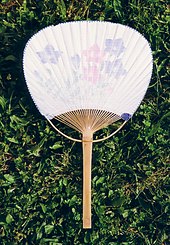
The Eastern fan (uchiwa) is Sasuke'southward clan symbol.[34]
Sasuke is a silent character who tries to gain more than power and kill his older brother, Itachi, for betraying and murdering their association.[35] He cares near his teammates and saves them on numerous occasions,[36] [37] [38] but he severs all of his bonds later in Part I, believing this volition strengthen him. Sasuke is moved when Naruto Uzumaki wants him to make peace with the village; he considers Naruto his only friend.[39] Sasuke becomes more than kindhearted by the finish of the series, only he decides not to render home, chooses to redeem himself, and searches for an enemy threatening the peace of Konohagakure.[40] Lowenthal said in 2010 that Sasuke was 1 of the first night characters he voiced, calculation, "He'due south sort of a hero, but he's not the naïve, young white–hat hero."[41]
When plot developments made Sasuke one of the story's antagonists, Kishimoto chosen him and Naruto yin and yang because of their differences and complementary natures.[8] During this period, he was asked whether Sasuke was good or evil; he replied that Sasuke was neither and chosen him a "very pure person."[42] He said although some of Sasuke's actions such as following his association's ideas were positive, his self-centeredness tended to cause issues with others. Since the beginning of the story's serialization, Kishimoto planned to conclude the serial with a fight betwixt Sasuke and Naruto, simply he was uncertain whether the characters would end up every bit friends or enemies.[43]
Scholars have also analyzed the character. In El Anime como elemento de Transculturación, Sasuke's corruption from a friend of the main character to his antagonist is considered i of the major interests in the narrative as it causes Naruto a dilemma about whether or not he will have to impale him during his growth equally a ninja, making information technology ane of the best written storylines presented in the narrative.[44] According to a report of readers' abilities to predict character types based on concrete cues, Sasuke was classified as an INTJ (Myers-Briggs) grapheme blazon, making him a foil for Naruto.[45] Rik Spanjers regarded Sasuke'southward dissimilarity to Naruto every bit tragic just wrote that the dissimilarity between the protagonists' approaches to the earth was fundamental to the plot: "Naruto's strength grows as he gains more loved ones to protect, while Sasuke remains alone and is increasingly captivated past his quest for revenge".[46] According to academic Amy Plumb, Kishimoto's references to Japanese mythology in Naruto, including the heraldic symbol of Sasuke's clan — a fan known as an uchiwa — added layers to the story and Sasuke's ability to 'blow away' the Nine-Tailed Fox's influence on Naruto resembled the mythological use of the fan to dispel evil.[34] Beatriz Peña viewed Sasuke's animosity in the serial as a result of the war theme oftentimes shown throughout the story, with the Uchihas having been slaughtered due to a possible civil war against Konohagakure, which expanded the connectedness between him and Naruto.[47]
Tejal Suhas Bagwe from Dissertation Submitted in Partial Fulfillment for the Degree of Masters of Arts in English describes the usage of god themed techniques within the Uchihas as major references to Japanese mythology especially when awakening the stronger Mangekyo Sharingan. Another reference is how Orochimaru becomes the mythical Yamata-no-Orochi during Sasuke's fight against Itachi who seals Orochimaru through his ain Susanoo similar to the myth. The series' final antagonist, Kaguya Otsutsuki, is based on Kaguya Hime. Similar to the references of the Sharingans, Kaguya too references Japanese mythology, with both Sasuke and Naruto being the descendants of her children in a similar style to Amaterasu, the powerful Goddess of the Sunday, and Susanoo, the God of thunder. The contrasting relations betwixt these two characters is a common theme within the manga, as non only this is explored through Naruto and Sasuke simply also through the two other connected ninjas, Hashirama Senju and Madara Uchiha.[48]
Appearances
In Naruto
In Part I
Sasuke is introduced in the third chapter of Naruto 's manga equally a immature ninja assigned to become a member of Team 7 alongside his rival Naruto Uzumaki and Sakura Haruno, the latter of whom is infatuated with him.[49] The trio are trained under the guidance of Kakashi Hatake.[50] Although Sasuke is antisocial, cold, and distant, he starts caring about Naruto and Sakura.[51] During a mission, Sasuke awakens his Sharingan — his clan'due south inherited power to see through illusions — which allows him to learn imperceptible movements at a superhuman charge per unit.[36] [52] It is revealed later that Sasuke is the sole survivor of the once-powerful Uchiha clan of Konohagakure. He, at the age of seven, survived the massacre of his clan perpetrated by his brother, Itachi, who spared Sasuke'southward life because he did not consider him worth killing.[53] Sasuke seeks strong fighting opponents to reassure himself his power is growing.[54]
During a ninja exam meant to improve their ranks, Squad 7 encounters Orochimaru, an exile from Konohagakure who afflicts Sasuke with a Cursed Seal that contains a fragment of Orochimaru'south consciousness, which increases Sasuke's physical abilities, but makes him cruel and sadistic.[55] [56] Kakashi teaches Sasuke the lightning-based offensive technique called Chidori in an try to gratify Sasuke's desire for ability.[57] During a siege of Konohagakure, a berserker ninja named Gaara beats Sasuke, who is rescued by Naruto. Presently after, Itachi returns to the village; Sasuke tries to impale him, but he is browbeaten and tortured instead. Shaken by the experience he decides to leave Team 7 and Konohagakure to become stronger.[58] Thinking Orochimaru's training will make him more powerful, Sasuke becomes an outlaw.[59] Naruto follows him and they fight when Sasuke refuses to return; Sasuke wins, spares Naruto'southward life, and continues to Orochimaru's hideout.[60]
In Part II
After two-and-a-half years of training, Sasuke absorbs Orochimaru before he tin can possess his younger body.[61] Following this, Sasuke forms Squad Hebi to find Itachi.[62] Itachi and Sasuke fight and Itachi dies at the climax of the battle from an illness.[63] Sasuke then meets Tobi, Itachi's superior, who reveals that Itachi killed the Uchiha clan under orders from Konohagakure and spared Sasuke out of love rather than contempt.[63] Sasuke rejoins Hebi — which he renames Taka — and declares his intention to destroy his former hamlet in retribution. Due to his brother'due south death, Sasuke's Sharingan has evolved into a Mangekyo Sharingan ( 万華鏡写輪眼 , Mangekyō Sharingan , lit. "Kaleidoscope Re-create Bicycle Heart"), giving him powerful new techniques.[64] Later on he agrees to work temporarily for Tobi'due south terrorist organization, Akatsuki, Sasuke becomes a criminal.[65] He kills Danzo Shimura — a mastermind of the Uchiha massacre and the acting Hokage, the leader of Konohagakure, at the time.[66] Sasuke is confronted by his one-time Team seven colleagues, and Naruto challenges him to a death match.[67]
Sasuke initially prepares to fight Naruto simply instead decides to protect Konohagakure after he encounters the re-animated bodies of Itachi[68] and the First Hokage.[69] [70] He rejoins Squad 7 and fights the Ten-Tails monster that is controlled past the masterminds behind Akatsuki.[71] [72] Sasuke inherits the Rinnegan — a legendary eye technique — from the spirit of the Sage of the 6 Paths Hagoromo Otsutsuki, the Founder of Shinobi. Team 7 fights and seals an ancient being called Kaguya Otsutsuki — Hagoromo'southward female parent — who created the Ten-Tails.[73] Sasuke then fights Naruto alone to settle their village'southward future;[74] when he loses his left arm, Sasuke surrenders and reconciles with Naruto.[39] Sasuke so destroys Akatsuki'southward illusion placed on mankind with his Rinnegan. He is pardoned for his crimes by Kakashi — the current Hokage — and decides to travel the globe in search of redemption. Before leaving, he says farewell to both Sakura and Naruto with gratitude.[40] By the cease of the manga, having briefly returned to the village, Sasuke is revealed to have married Sakura who is raising their daughter Sarada.[75]
In the Boruto franchise
In the Naruto spin-off manga, Naruto: The Seventh Hokage and the Scarlet Jump, and the Boruto: Naruto Next Generations anime (2017), Sasuke has left Konohagakure sometime after Sarada's nativity on a surreptitious mission to investigate a possible threat relating to Kaguya, traveling beyond the world and Kaguya's dimensions for clues while aiding the other villages in hush-hush. In the Boruto anime, Sasuke briefly returns to his village earlier the arc begins and asks Naruto to offer Sakura his apologies.[28] He rejoins Naruto to oppose Orochimaru'southward erstwhile test bailiwick Shin, who takes the Uchiha surname for his own while seeking to avenge Itachi and revive the Akatsuki to end the peace. After defeating Shin and his clone children, Sasuke bonds with his daughter for the start time and resumes his mission.[76] A novel by Mirei Miyamoto focuses on Sasuke'due south piece of work in his village where he replaces Konohamaru Sarutobi as the leader of Boruto, Sarada, and Mitsuki's team.[77] Some other novel which is being adjusted into a manga is focused on a new run a risk Sasuke and Sakura. The theme of Sasuke'southward novel is that of "a married couple'south view on life and expiry".[78] [79]
In Boruto: Naruto the Picture show, also covered in both the Boruto manga and anime, Sasuke returns to Konohagakure to warn Naruto of the threat posed by Kaguya's kinsmen Momoshiki Otsutsuki and Kinshiki Otsutsuki, who seek the tailed beast chakra for their end.[80] [81] He meets Naruto'southward son, Boruto, and becomes the boy's mentor one time having him learn to utilise his begetter'southward Rasengan ( 螺旋丸 , lit. screw sphere, English manga: "Spiral Chakra Sphere"). When the Otsutsuki members abduct Naruto during the Chunin Examination, Sasuke is accompanied by Boruto as he and the Kage — the leaders of the ninja villages — travel to Momoshiki's planet to save Naruto. Sasuke then aids Naruto and Boruto in defeating Momoshiki, who absorbs Kinshiki to increment his power.[80] Later Momoshiki's defeat, Sasuke notices the enemy has placed a seal on Boruto.[82] The anime has Sasuke searching Urashiki Otsutsuki alongside Gaara.[83] In the manga, Sasuke learns the Otsutsuki clan are connected to Kara and faces them with Naruto, noting that he might die in combat due to their superior powers.[84]
In other media
Sasuke appears in the starting time four original video animations (OVAs) produced for the serial. In the first episode, he helps Naruto and Konohamaru find a four-leaf clover;[85] in the second, he joins Naruto's team for a mission;[85] he participates in a tournament in the third; and he works with Team 7 in the quaternary.[86] [87] 1 OVA presents an alternate fight between Sasuke and Naruto in Naruto: Shippuden.[88] The grapheme is nowadays in the first two Naruto characteristic films; he guards a princess in Naruto the Picture: Ninja Clash in the State of Snow (2004) and makes a brief appearance in a flashback in Naruto the Flick: Legend of the Stone of Gelel (2005).[89] The first Part 2 movie in which he appears is Naruto Shippuden 2: Bonds (2008).[90] The sixth Part II flick, Road to Ninja: Naruto the Motion-picture show (2012), contains a flirtatious, alternate-reality version of Sasuke.[91] In The Last: Naruto the Movie (2014), an adult Sasuke returns briefly to Konohagakure to protect information technology from a meteor.[92]
He is a recurring character in the Naruto low-cal novels and the protagonist of the manga Naruto Jinraiden: The Twenty-four hour period the Wolf Howled (2012), which explores Sasuke'southward reflections after Itachi's death and his decision to destroy Konohagakure.[93] In Sakura Hiden (2015), an adult Sasuke continues his journeying of redemption just returns to Konohagakure out of business for Sakura's prophylactic.[94] In Akatsuki Hiden (2015), Sasuke meets two children who tell him stories about Akatsuki, and they discuss Itachi's legacy.[95] He is the protagonist of Sasuke Shinden (2015); he agrees to aid Konohagakure by investigating a series of disappearances, which he solves with the help of Taka and a Konohagakure ninja named Sai.[96] Sasuke is also the protagonist of manga artist Kenji Taira'south Naruto spin-off, Sasuke Uchiha's Sharingan Fable (2014), in which he and Taka search for Itachi. According to Taira, Sasuke would be characterized as an "idiot."[97] A new novel focused on Sasuke's life as an developed alongside Sakura, Sasuke Retsuden: The Uchiha Descendants and the Heavenly Stardust (2019), was written by Jun Esaka.[98]
Sasuke is a playable character in Naruto video games, including the Disharmonism of Ninja and Ultimate Ninja series.[99] [100] [101] His Cursed Seal can exist unlocked and activated in some games. Due to his absence from early Naruto: Shippuden episodes, Sasuke has non appeared in any games based on Naruto: Shippuden until the launch of Gekitō Ninja Taisen! EX 2 and Ultimate Ninja five (2007).[102] Sasuke is besides present in crossover games, such as Bound Super Stars (2005), Boxing Stadium D.O.N (2006), Bound Ultimate Stars (2006), J-Stars Victory VS (2014), and Jump Strength (2019).[103] [104] [105] [106]
Cultural affect
Popularity
Sasuke has ranked among the superlative-five Naruto characters in every Weekly Shōnen Jump popularity poll of the series. Initially alternate between tertiary and fourth places, he has finished first twice.[107] [108] A popularity poll on the Japanese website Charapedia ranked Sasuke and Naruto's rivalry equally the best in anime.[109] Similarly, Sasuke was voted equally the second best rival in manga and anime in a poll past Anime Anime.[110] At New York's 2015 Comic-Con, moderator Christopher Butcher and editor Jo Otsuki commented that Sasuke had become the series' most popular character, and Otsuki called him his favorite. Butcher wondered whether readers considered Sasuke a more-relatable graphic symbol after he had embraced Naruto'south positive outlook on life in the series finale. According to Otsuki, fans regarded Sasuke'due south grapheme and abilities as "cooler" than those of his rival.[111] Jacob Promise of Anime News Network (ANN) listed Sasuke and Naruto equally ii of the "Fiercest Frenemies" in anime due to their resemblance despite existence adversaries and their need to engage in a mortal fight to become friends.[112] In a Tokyo Otaku Manner poll, Sasuke was accounted the 6th best graphic symbol women would want to have a date with.[113] IGN as well listed him as 1 of the 10 best rivals in anime in general,[114] while a poll from Anime! Anime! listed Naruto and him as 1 of the all-time rivals turned into allies.[115] In poll from 2021, Sasuke was voted every bit the fifth best character from Boruto: Naruto Next Generations.[116]
Upon seeing the final fight between Sasuke in the game, CyberConnect2 CEO Hiroshi Matsuyama admitted he got emotional.[117] Matsuyama too made his ain sketch of Sasuke, aiming to put in the video game when he faces Naruto.[118] Matsuyama further reflected the anime'south 133rd episode to exist one of his favorites not only for the action sequences between Naruto and Sasuke but also the emotional value displayed.[119]
Merchandise
Sasuke merchandise includes key chains[120] and figurines.[121] [122] [123] Boruto film audiences were offered fans bearing images of Sasuke and his daughter, Sarada.[124] To promote the video game Naruto Shippuden: Ultimate Ninja Tempest four, two 1/6-scale statues depicting Sasuke and Naruto during their final disharmonism from the series were developed by Luxemburgish visitor Tsume.[125]
Japanese toy visitor Bandai released an action figure of Sasuke performing the Chidori motion.[126] In May 2017, Bandai launched a figurine of Sasuke performing his Susanoo eye technique, which represents the god of thunder Raijin. Studio Pierrot released artwork that was sold alongside this effigy.[127] Bandai besides produced a limited-edition adult figurine of Sasuke as he appears in the Naruto finale and the Boruto franchise, which impressed Scott Light-green, a writer for Own't It Cool News and Crunchyroll.[128] [129]
Critical response
Sasuke's graphic symbol has received both praise and criticism in online and printed publications.[130] Reviewing the series' get-go part, writers said they enjoyed Sasuke's fights but disapproved of his night personality, which resembled the stereotypical rival in shōnen manga.[131] [132] [133] Critics commended the relationship betwixt Sasuke, Naruto, and Sakura; they regarded the characters equally complex and mature considering of their teamwork and despite their youth.[134] [135] Reviewers considered that the characters' tactics and the emphasis on their rivalry'southward emotional undercurrents made Sasuke and Naruto's final fight from the story's first role one of the near entertaining in the series,[136] [137] and they praised the i-sided romantic relationship between Sasuke and Sakura.[138] [139] Although critics enjoyed Yuri Lowenthal'due south voicing of Sasuke,[140] Theron Martin of ANN said the actor had difficulty sounding younger in flashbacks.[141]
Reviewers were more enthusiastic about Sasuke'south grapheme in the second part of the series. Critics stated that his more-emotional demeanor and his conversation with the Ix-Tailed Fox — a brute sealed within Naruto's torso — fabricated his scenes in Naruto: Shippuden interesting.[142] [143] Jason Thompson wrote that Sasuke had non become evil despite siding with the antagonist Orochimaru, lending ambiguity to his character.[144] Writers believed Sasuke's fights during the story's kickoff function's climax against Naruto second part had a major bear upon on the plot and the character,[145] [146] [147] and they regarded his battles as some of the franchise'due south best.[148]
The series finale garnered praise from critics for the intensified rivalry between Naruto and Sasuke considering of the characters' similarities.[149] [150] Reviewers also applauded Sasuke'southward acknowledgement of his crimes, his agreement to go to prison house, and his conclusion to begin a journeying of redemption, indicating an acceptance of responsibility for his misdeeds and a response to Sakura'southward feelings.[151] Writers thought the character's monologue after his terminal fight with Naruto highlighted his deeper side and that his adieu was a satisfying catastrophe to the final story arc.[152] [153]
Sasuke has connected to receive praise following the end of the Naruto series. Writers considered his fight scenes in Boruto: Naruto the Flick and in detail his teamwork with Naruto to be the best parts of the motion-picture show,[154] [155] [156] [157] with its television series also received critical acclaimed to the bespeak of finding equally highly-seasoned as the final fight from Shippuden between Sasuke and Naruto.[158] A like assessment was fabricated of Sasuke'southward characterization as an adult; Chris Beveridge of The Fandom Post approved of his new personality.[159] Critics also commented that Sasuke had become more caring toward his daughter,[160] [161] and they said the Boruto anime had adult Sasuke every bit a father and a husband and had solidified his relationship with his wife, Sakura,[162] [163] despite his flawed interaction with his family due to his mission to terminate Kaguya's followers in society to absolve for his past actions and protect his hometown in the process.[164] [165] Sasuke's interaction with Boruto likewise earned praise by Anime News Network for how supportive he is on his student when Boruto is depressed about his father's disappearance and he encourages to join his rescue squad to find him.[166] The character's possible mortal fate in the fight against Kara was found past IGN to be a common commentary within readers who feared Sasuke dying in the narrative based on build upwardly where he tells Boruto he and Naruto are ready to die protecting the village.[167]
See as well
-
 Anime and manga portal
References
- ^ Shonen Leap. Viz Media. 2007. p. 366. ISSN 1545-7818.
- ^ "Interview: Tracking Down the Source". Shonen Jump Naruto Collector iii. Viz Media. August 2007.
- ^ "Naruto: The Beginning". Jump Foursquare (in Japanese). Shueisha (12–14). December 2014.
- ^ Kishimoto, Masashi (December four, 2009). Naruto―ナルト―[秘伝·皆の書]オフィシャルプレミアムファンBook [Naruto Hole-and-corner · Everyone's Book Official Premium Fan]. Naruto (in Japanese). Shueisha. p. 190. ISBN978-4-08-874834-iv.
- ^ Kishimoto, Masashi (2007). Uzumaki: the Art of Naruto. Viz Media. p. 140. ISBN978-1-4215-1407-nine.
- ^ a b "ナルト 本当に終わっちゃうの?" [Naruto Is it actually going to end?]. Entermix (in Japanese). No. Nov 2014. Kadokawa. 2014. p. lxx. ASIN B01LEPKJ28.
- ^ Kishimoto, Masashi (2007). Uzumaki: the Art of Naruto. Viz Media. p. 140. ISBN978-1-4215-1407-9.
- ^ a b Kido, Misaki C. (Feb 2012). "Interview with Masashi Kishimoto (Creator of Naruto)". Weekly Shonen Jump Blastoff. Viz Media (2–06–12): 120–123.
- ^ a b Kishimoto, Masashi (2013). Naruto-ナルト-名言集 絆-Kizuna- 天ノ巻 [Naruto Bonds: The Words That React]. Shueisha. pp. 188–195. ISBN978-4-08-720681-4.
- ^ a b c 漫道コバヤシ第13号「Naruto完結!岸本斉史SP」 [Kobayashi No. thirteen 'Completion of Naruto! Masashi Kishimoto SP' ] (in Japanese). Fuji Television. Dec 13, 2014.
- ^ Aoki, Deb (October 14, 2015). "Masashi Kishimoto at New York Comic-con The Anime News Network Interview". Anime News Network. Archived from the original on Oct 19, 2016.
- ^ "ラストバトルの裏話" (in Japanese). Pierrot. Retrieved October 18, 2019.
- ^ "Boruto: Naruto the Movie". CinemaToday.jp (in Japanese). Cinema Today. Archived from the original on June 17, 2016. Retrieved June 14, 2017.
- ^ "岸本聖史×岸本斉史 双子漫画家兄弟対談" [Seishi Kishimoto × Masashi Kishimoto twin brothers manga creative person interview]. GanganOnline.com. Square Enix. Archived from the original on August 7, 2016.
- ^ Boruto: Naruto the Picture (DVD). 2015. Studio: Pierrot.
- ^ "「Boruto: Naruto the Flick-」剧场版上映前特别节目" [Motion-picture show Version Before Screening Special Separation Clause]. AcFun (in Japanese). August v, 2015. Archived from the original on Jan 7, 2018. Retrieved Jan 6, 2018.
- ^ a b c d Kishimoto, Masashi (2004). Naruto. Vol. 3. Viz Media. p. 26. ISBN978-1-59116-187-5.
- ^ a b Kishimoto, Masashi (2008). Naruto -ナルト- 秘伝・者の書 キャラクターオフィシャルデータBook [Naruto Secret: Whorl of People Grapheme Official Databook] (in Japanese). Shueisha. p. 343. ISBN978-4-08-874247-2.
- ^ Kishimoto, Masashi (2014). Naruto―ナルト―キャラクターオフィシャルデータBook 秘伝・陣の書 [Naruto Character Official Information Book Secret · Book of Guys] (in Japanese). Shueisha. pp. 378–387. ISBN978-iv-08-880263-3.
- ^ Kishimoto, Masashi (December 4, 2009). Naruto―ナルト―[秘伝·皆の書]オフィシャルプレミアムファンBook [Naruto Hugger-mugger · Anybody's Book Official Premium Fan]. Naruto (in Japanese). Shueisha. pp. 74–81. ISBN978-four-08-874834-iv.
- ^ a b Kishimoto, Masashi (2007). Uzumaki: the Art of Naruto. Viz Media. p. 124. ISBN978-1-4215-1407-9.
- ^ Kishimoto, Masashi (2007). Uzumaki: the Art of Naruto. Viz Media. p. 130. ISBN978-ane-4215-1407-9.
- ^ "The Last -Naruto the Movie-'s Sasuke, Kakashi Grapheme Designs Unveiled". Anime News Network. November 14, 2014. Archived from the original on May 1, 2017. Retrieved June 14, 2017.
- ^ Kishimoto, Masashi (2014). Naruto -ナルト- 秘伝・列の書 オフィシャルムービーガイドBook [Naruto Hole-and-corner: Scroll of Line Official Flick Guidebook]. Shueisha. pp. 63–64.
- ^ "イタチのエニグマ" [The Enigma that is Itachi]. Five Jump (in Japanese). No. March 2016. Shueisha. 2016. pp. 320–321.
- ^ Naruto -ナルト- 疾風伝 師の予言と復讐 [Naruto Shippuden Master'southward Prophecy and Vengeance half dozen] (in Japanese). Aniplex. 2011.
- ^ "演者もワクワクし、驚いたラストの衝撃的な展開" [Even the actors are excited, the shocking unfolding of the surprising ending]. Da Vinci (in Japanese). No. May. Kadokawa. 2015. pp. 32–35.
- ^ a b Kitahata, Yukihiro. "Naruto Side Story to Go an Episode in Boruto". Manga Tokyo. Archived from the original on October 17, 2017. Retrieved October 17, 2017.
- ^ "Boruto Ed" (in Japanese). Animedia. Retrieved September xi, 2019.
- ^ Bozon, Mark (July 21, 2006). "Comic-Con 2006: Naruto Party Interview". IGN. Archived from the original on Dec 4, 2007. Retrieved December thirty, 2007.
- ^ Alessandra, Lauren (Baronial 6, 2010). "Yuri Lowenthal On Prince of Persia, Amongst Other Things". Gaming Union. Archived from the original on June 27, 2015. Retrieved June thirteen, 2017.
- ^ "Naruto Collector". Naruto Collector. Viz Media (June 2006). 2006.
- ^ "Yuri Lowenthal Speaks well-nigh Sasuke". Siliconera. March 1, 2006. Archived from the original on September 12, 2017. Retrieved September 12, 2017.
- ^ a b Plumb, Amy (2010). "Japanese Religion, Mythology, and the Supernatural in Anime and Manga". The International Journal of the Humanities. 8 (five): 237–246. doi:ten.18848/1447-9508/CGP/v08i05/42930. ISSN 1447-9508.
- ^ Kishimoto, Masashi (2003). "Chapter 4". Naruto. Vol. 1. Viz Media. ISBN978-1-56931-900-0.
- ^ a b Kishimoto, Masashi (2004). "Chapter 27". Naruto. Vol. 3. Viz Media. ISBN978-ane-59116-187-five.
- ^ Kishimoto, Masashi (2007). "Affiliate 133". Naruto. Vol. 15. Viz Media. ISBN978-ane-4215-1089-vii.
- ^ Kishimoto, Masashi (2004). "Affiliate 138". Naruto. Vol. sixteen. Viz Media. ISBN978-1-4215-1090-3.
- ^ a b Kishimoto, Masashi (2015). "Chapter 698". Naruto. Vol. 72. Viz Media. ISBN978-i-4215-8284-ix.
- ^ a b Kishimoto, Masashi (2015). "Affiliate 699". Naruto. Vol. 72. Viz Media. ISBN978-i-4215-8284-9.
- ^ K., Luke. "Yuri Lowenthal: MCM Expo 2010 interview (role one)". Critical Gamer. Archived from the original on November 25, 2013. Retrieved June 13, 2017.
- ^ "Interview with Masashi Kishimoto (Creator of Naruto)". Weekly Shōnen Bound. Viz Media (ii–03–14). February 2014. Archived from the original on February 22, 2014.
Masashi Kishimoto: Sasuke is basically a very pure person who does not think about whether what he does is proficient or bad. He simply does what he does which causes troubles for others.
- ^ "Masashi Kishimoto: Fan letters from overseas made me realize the popularity of 'Naruto'". ajw.asahi.com. Asashi. November x, 2014. Archived from the original on November 10, 2014. Retrieved Nov 10, 2014.
- ^ Antonio, Luis; Perez, Vidal (2010). "El Anime como elemento de Transculturación. Caso Naruto" (PDF). Universidad Cesar Vallejo (in Spanish). p. 31. Retrieved June 22, 2020.
- ^ Chen, Ming-Hung; Chen, I-Ping (June 8, 2015). "The Relationship Between Personalities and Faces of Manga Characters". The Comics Grid: Journal of Comics Scholarship. 4 (ane). doi:10.5334/cg.bc.
- ^ Spanjers, Rik (2013). "Naruto". In Beaty, Bart H.; Weiner, Stephen (eds.). Disquisitional Survey of Graphic Novels : Manga. Salem Press. pp. 215–221. ISBN978-one-58765-955-3 – via EBSCOhost.
- ^ Peña, Beatriz (2013). Pop Culture: A Reader. Cambridge University Press. Cambridge Scholars Publishing. p. 109. ISBN9781443853729.
- ^ Tejal Suhas Bagwe; Shweta Salian (February 2020). "Chapter 1". The relevance of the Japanese myth of creation and the Tale of Jiraiya in the anime manga series Naruto. Section of Languages. Retrieved June viii, 2021.
{{cite book}}: CS1 maint: multiple names: authors list (link) - ^ Kishimoto, Masashi (2003). "Chapter iii". Naruto. Vol. i. Viz Media. ISBN1-56931-900-six.
- ^ Kishimoto, Masashi (2003). "Chapter 8". Naruto. Vol. 2. Viz Media. ISBN978-1-59116-178-3.
- ^ Kishimoto, Masashi (2004). "Affiliate xix". Naruto. Vol. 3. Viz Media. p. 40. ISBN978-1-59116-187-5.
- ^ Kishimoto, Masashi (2007). "Chapter 230". Naruto. Vol. 26. Viz Media. pp. 74–75. ISBN978-1-4215-1862-6.
- ^ Kishimoto, Masashi (2007). "Affiliate 225". Naruto. Vol. 25. Viz Media. ISBN978-1-4215-1861-9.
- ^ Kishimoto, Masashi (2004). "Chapter 38". Naruto. Vol. v. Viz Media. ISBN978-ane-59116-359-half-dozen.
- ^ Kishimoto, Masashi (2005). "Chapter 56". Naruto. Vol. seven. Viz Media. ISBN978-1-59116-875-1.
- ^ Kishimoto, Masashi (2007). "Affiliate 184". Naruto. Vol. 21. Viz Media. pp. 68–72. ISBN978-ane-4215-1855-viii.
- ^ Kishimoto, Masashi (2007). "Affiliate 128". Naruto. Vol. fifteen. Viz Media. pp. 35–36. ISBN978-one-4215-1855-viii.
- ^ Kishimoto, Masashi (2007). "Affiliate 176". Naruto. Vol. xx. Viz Media. ISBN978-1-4215-1655-iv.
- ^ Kishimoto, Masashi (2007). "Chapter 179". Naruto. Vol. twenty. Viz Media. pp. 155–157. ISBN978-one-4215-1655-4.
- ^ Kishimoto, Masashi (2007). "Chapter 234". Naruto. Vol. 26. Viz Media. pp. 161–163. ISBN978-1-4215-1862-6.
- ^ Kishimoto, Masashi (2009). "Chapter 343". Naruto. Vol. 38. Viz Media. ISBN978-1-4215-2174-9.
- ^ Kishimoto, Masashi (2009). "Affiliate 380". Naruto. Vol. 42. Viz Media. ISBN978-1-4215-2843-four.
- ^ a b Kishimoto, Masashi (2009). "Affiliate 401". Naruto. Vol. 43. Viz Media. ISBN978-1-4215-2929-5.
- ^ Kishimoto, Masashi (2008). "Affiliate 402". Naruto. Vol. 43. Viz Media. ISBN978-1-4215-2929-5.
- ^ Kishimoto, Masashi (2009). "Chapter 419". Naruto. Vol. 45. Viz Media. ISBN978-1-4215-3135-9.
- ^ Kishimoto, Masashi (2010). "Chapter 457". Naruto. Vol. 49. Viz Media. ISBN978-1-4215-3475-6.
- ^ Kishimoto, Masashi (2011). "Chapter 486". Naruto. Vol. 52. Viz Media. ISBN978-1-4215-3957-vii.
- ^ Kishimoto, Masashi (2012). "Chapter 590". Naruto. Vol. 62. Viz Media. ISBN978-4-08-870515-6.
- ^ Kishimoto, Masashi (2012). "Chapter 593". Naruto. Vol. 62. Viz Media. ISBN978-iv-08-870515-half-dozen.
- ^ Kishimoto, Masashi (2014). "Chapter 627". Naruto. Vol. 65. Viz Media. ISBN978-1-4215-6455-v.
- ^ Kishimoto, Masashi (2014). "Chapter 631". Naruto. Vol. 66. Viz Media. ISBN978-1-4215-6948-ii.
- ^ Kishimoto, Masashi (2014). "Chapter 655". Naruto. Vol. 68. Viz Media. ISBN978-1-4215-7682-iv.
- ^ Kishimoto, Masashi (2015). "Chapter 679". Naruto. Vol. 70. Viz Media. ISBN978-i-4215-7975-7.
- ^ Kishimoto, Masashi (2015). "Chapter 692". Naruto. Vol. 72. Viz Media. ISBN978-1-4215-8284-ix.
- ^ Kishimoto, Masashi (2015). "Chapter 700". Naruto. Vol. 72. Viz Media. ISBN978-one-4215-8284-nine.
- ^ Kishimoto, Masashi (2016). Naruto: The Seventh Hokage and the Scarlet Spring. Viz Media. ISBN978-1421584935.
- ^ Miyamoto, Mirei; Kishimoto, Masashi (2018). Naruto -ナルト- サスケ新伝 師弟の星 [Sasuke Shinden: The Teacher's Star Student]. Shueisha. ISBN978-4-08-703450-9.
- ^ "Naruto Franchise's 'Retsuden' Novel Serial Get two More Installments for Naruto, Sasuke (Updated)". Anime News Network. June 2, 2019. Retrieved Feb 4, 2022.
- ^ "2 Naruto Novels Get Manga Adaptations in 2022". Anime News Network. December eighteen, 2021. Retrieved Feb 4, 2022.
- ^ a b McNulty, Amy (October ix, 2015). "Boruto -Naruto the Movie-". Anime News Network. Archived from the original on April 20, 2018. Retrieved Apr 20, 2018.
- ^ Kishimoto, Masashi; Ikemoto, Mikio; Kodachi, Ukyō (2017). "1". Boruto: Naruto Adjacent Generations. Vol. one. Viz Media. ISBN9781421592114.
- ^ Kishimoto, Masashi; Ikemoto, Mikio; Kodachi, Ukyō (2018). "Chapter xi". Boruto: Naruto Next Generations. Vol. 3. Viz Media. ISBN978-one-4215-9822-2.
- ^ "With Sasuke As The Goal". Boruto: Naruto Next Generations. Studio Pierrot. August xviii, 2019.
- ^ "Boruto: Naruto Side by side Generations, Chapter 38". Viz.com. Archived from the original on September 20, 2019. Retrieved September 20, 2019.
- ^ a b Naruto OVA – The Lost Story. Viz Video. 2007. Archived from the original (DVD) on December 17, 2007. Retrieved August 29, 2013.
- ^ ついに激突!上忍VS下忍!!無差別大乱戦大会開催!! [Finally a disharmonism! Jonin VS Genin!! Indiscriminate grand melee tournament coming together!!] (DVD). Boob tube Tokyo. 2005.
- ^ "Naruto, Toriko, 1 Piece Upshot Anime Shorts Streamed". Anime News Network. Nov xxx, 2009. Archived from the original on November viii, 2016. Retrieved November xxx, 2009.
- ^ "News: Naruto Anime DVD Offered at Uniqlo T-Shirt Stores". Anime News Network. Dec 20, 2010. Archived from the original on November 6, 2016.
- ^ Naruto the Movie: Ninja Clash in the Land of Snow. Viz Video. 2007. Archived from the original (DVD) on March 23, 2013.
- ^ Naruto Shippuden: The Movie – Bonds (DVD). Viz Video. 2011.
- ^ Road to Ninja: Naruto the Picture (DVD). Viz Video. 2012. Archived from the original on December 12, 2017.
- ^ The Last: Naruto the Movie (Blu-ray). Viz Video. 2015.
- ^ Higashiyama, Akira; Kishimoto, Masashi (2012). Naruto -ナルト- 迅雷伝 狼の哭く日 [Naruto Jinraiden: The Day the Wolf Howled]. Shueisha. ISBN978-4-08-703279-6.
- ^ Tomohito, Ōsaki; Kishimoto, Masashi (2016). サクラ秘伝 思恋、春風にのせて [Naruto: Sakura'southward Story — Love Riding the Bound Cakewalk]. Shueisha. ISBN978-1-42-158442-3.
- ^ Towada, Shin; Kishimoto, Masashi (2015). Naruto: 暁秘伝 咲き乱れる悪の華 [Naruto Akatsuki Hiden: Evil Flowers in Full Bloom] (in Japanese). Shueisha. ISBN978-4-08-703367-0.
- ^ Towada, Shin; Kishimoto, Masashi (2017). Naruto: Sasuke's Story — Sunrise. Viz Media. ISBN978-ane-42-159129-ii.
- ^ Taira, Kenji (2017). Naruto: Chibi Sasuke's Sharingan Fable. Vol. 1. Viz Media. p. 1. ISBN978-1421597102.
- ^ Esaka, Jun; Kishimoto, Masashi (2019). NARUTO -ナルト- サスケ烈伝 うちはの末裔と天球の星屑 [Sasuke Retsuden: The Uchiha Descendants and the Heavenly Stardust]. Shueisha. ISBN978-4-08-703481-3.
- ^ Bozon, Marking (September 29, 2006). "Naruto: The Complete Fighter Profile". IGN. Archived from the original on May 16, 2010. Retrieved January 24, 2007.
- ^ Alfonso, Andrew (September 26, 2004). "TGS 2004: Naruto Gekitou Ninja Taisen! 3 Hands-on". IGN. Archived from the original on March four, 2009. Retrieved January 24, 2007.
- ^ Naruto: Ultimate Ninja English instruction manual. Bandai Namco. 2006. p. 26.
- ^ 5 Bound (in Japanese). Shueisha. 2007. pp. 54–55.
- ^ "Jump Super Stars -Characters". nintendo.co.jp (in Japanese). Nintendo. Archived from the original on June 30, 2016. Retrieved December xi, 2017.
- ^ "Jump Ultimate Stars Characters". nintendo.co.jp (in Japanese). Nintendo. Archived from the original on June thirty, 2016. Retrieved December xi, 2017.
- ^ "Naruto/Dragon Brawl/Toriko Rivals, Transformations in J-Stars Victory Vs. Game". Anime News Network. August 28, 2013. Archived from the original on Baronial 28, 2013. Retrieved August 29, 2013.
- ^ "Battle Stadium D.O.North." Siliconera. July 31, 2006. Archived from the original on June ix, 2017. Retrieved December 11, 2017.
- ^ Kishimoto, Masashi (2008). "Chapter 245". Naruto. Vol. 28. Viz Media. pp. 8–nine. ISBN978-1-4215-1864-0.
- ^ Kishimoto, Masashi (2008). "Chapter 293". Naruto. Vol. 33. Viz Media. ISBN978-one-4215-2001-8.
- ^ Schley, Matt. "Japanese Fans Rank Anime's Nearly Memorable Rivalries". Otaku USA. Archived from the original on July 21, 2015. Retrieved October 22, 2016.
- ^ "Japanese Fans Rank Anime'due south Greatest Rivals". Otaku U.s.a.. Sovereign Media. Retrieved June vii, 2019.
- ^ Aoki, Deb (October 14, 2015). "Office Ii – An Evening with Masashi Kishimoto". Anime News Network. Archived from the original on May 29, 2017. Retrieved June nine, 2017.
- ^ Chapman, Jacob Hope (June viii, 2016). "Anime's Fiercest Frenemies". Anime News Network. Archived from the original on October 29, 2016. Retrieved July 1, 2016.
- ^ "Tokyo Otaku Manner Fall 2013 User Poll". Otaku Mode. Dec 1, 2013. Retrieved May xx, 2018.
- ^ "Los ten rivales más grandes del anime". IGN (in Spanish). August thirty, 2018. Retrieved July 18, 2020.
- ^ "Results for Survey on the best Rivals that Turned Into Comrades". AnimeAnime. January 23, 2020. Retrieved July xviii, 2020.
- ^ "Boruto Popularity Poll Results May 2021". Viz Media . Retrieved July 11, 2021.
- ^ "The Sound Four Join Naruto Shippuden: Ultimate Ninja Storm 4 on PS4". PlayStation Blog. Jan 28, 2016. Retrieved June xxx, 2020.
- ^ Hiroshi Matsuyama [@PIROSHI_CC2] (February 3, 2016). "本日発売!『NARUTOーナルトー ナルティメットストーム4』。最後の闘いでサスケが一瞬こんな表情をする演出があります。"ある意味この瞬間に決着はついてるんだよ!"なんて話しながら作りました。どこなのか探してみてください。。" (Tweet) (in Japanese). Retrieved July 17, 2020 – via Twitter.
- ^ Hiroshi Matsuyama [@PIROSHI_CC2] (September 21, 2020). "定期的にテレビアニメ『NARUTO-ナルト-』133話を観返して自分自身の原点に立ち戻る。いくつもある神作画回がオレを強くしてくれる。こうした映像を「たまらない」と感じるオレが正しいって気付かせてくれる。やっぱりたまらない。涙の咆哮! オマエはオレの友達だ" (Tweet). Retrieved September 21, 2020 – via Twitter.
- ^ "Naruto – Keychains – Sasuke PVC Keychain". NarutoStore.Viz.com. Viz Media. Archived from the original on May 29, 2008. Retrieved Jan 24, 2008.
- ^ "Naruto Toys – Action Figures at Official Naruto Shop". NarutoStore.Viz.com. Viz Media. Archived from the original on February 3, 2008. Retrieved January 24, 2008.
- ^ "Naruto – Toys – Sasuke Roto eight" Figure". NarutoStore.Viz.com. Viz Media. Archived from the original on February 12, 2008. Retrieved January 24, 2008.
- ^ Green, Scott (Oct 31, 2012). "Love and Ninja Included in New "Naruto" Prize Figure Lottery". Crunchyroll. Archived from the original on May 11, 2018. Retrieved May 11, 2018.
- ^ "Naruto Creator on Existence Asked for Sequel: 'Please Let Me Rest Now'". Anime News Network. July 28, 2015. Archived from the original on July 1, 2017. Retrieved October 18, 2017.
- ^ "Namco Bandai Europe Teases Naruto Shippūden: Ultimate Ninja Storm 4 Bonus Figures". Anime News Network. December ix, 2015. Archived from the original on August 1, 2017. Retrieved February 22, 2018.
- ^ Orsini, Lauren (February 21, 2017). "Figure Build Shut-up: 2016 S.H. Figuarts Naruto & Sasuke". Anime News Network. Archived from the original on August 1, 2017. Retrieved February 22, 2018.
- ^ "Naruto, Sasuke God Figures Make a Storm This September". Anime News Network. May xvi, 2017. Archived from the original on July 31, 2017. Retrieved February 22, 2018.
- ^ Green, Scott (March 14, 2016). "Express "Boruto -Naruto The Picture show-" Sasuke Uchiha G.Due east.One thousand. Figure Planned". Crunchyroll. Otter Media. Archived from the original on July 11, 2017. Retrieved February 22, 2018.
- ^ "G.E.Grand.シリーズ Boruto -Naruto the Film- うちはサスケ" [Thousand.East.K. Serial Boruto -Naruto the Picture- Sasuke Uchiha]. P-Bandai.jp (in Japanese). Bandai. Archived from the original on July 15, 2017. Retrieved February 22, 2018.
- ^ Sparrow, A. East. (November 9, 2007). "IGN: Naruto Reader'southward Guide". IGN. Archived from the original on February 16, 2012. Retrieved December 22, 2007.
- ^ Dodson, Joe (October 13, 2007). "Franchise Player: Naruto". GameSpot. Archived from the original on October 25, 2007. Retrieved December 24, 2007.
- ^ Kimlinger, Carl (November two, 2006). "Naruto M.novel 8–ten". Anime News Network. Archived from the original on Feb four, 2010. Retrieved Apr v, 2009.
- ^ Christina, Ross. "THEM Anime Reviews 4.0 – Naruto". T.H.E.M. Anime Reviews. Archived from the original on June 8, 2009. Retrieved Jan 24, 2008.
- ^ Moure, Dani (September one, 2006). "Naruto Unleashed Ready i.ane". Mania Entertainment. Archived from the original on October 5, 2012. Retrieved September 4, 2009.
- ^ Yadao, Jason S. (2009). "Naruto". The Crude Guide to Manga . Rough Guides. p. 159. ISBN978-1858285610.
- ^ Jones, Davey C. (Oct 7, 2008). "Naruto Uncut Box Set ten Limited Edition (Adnace Review)". Active Anime. Archived from the original on July 7, 2011. Retrieved November 7, 2008.
- ^ White, Charles (Jan 22, 2008). "Naruto: "For a Friend" Review". IGN. Archived from the original on September 28, 2008. Retrieved November 7, 2008.
- ^ Williams, Bronwyn; Zenger, Amy A. (2012). "My Love". New Media Literacies and Participatory Popular Culture Beyond Borders. Routledge. p. 38. ISBN978-0415897686.
- ^ White, Charles (October 23, 2007). "Naruto: "An Invitation From The Sound" Review". IGN. Archived from the original on November 8, 2012. Retrieved June xiii, 2017.
- ^ "Review: "Boruto: Naruto the Moving picture" – The Kids Are (By and large) Alright". Toon Zone. May 24, 2017. Retrieved February 24, 2018.
- ^ Martin, Theron (November 7, 2008). "Naruto Season 3 Box Set 1 DVD". Anime News Network. Archived from the original on September 2, 2013. Retrieved June sixteen, 2017.
- ^ Kimlinger, Carl (December 12, 2010). "Naruto Shippūden DVD Box Set 4". Anime News Network. Archived from the original on November 19, 2016. Retrieved October 8, 2011.
- ^ Beveridge, Chris (Nov 17, 2010). "Naruto: Shippuden Box Set 04 (also w/LE)". Mania Entertainment. Archived from the original on Nov 19, 2010. Retrieved October viii, 2011.
- ^ Thompson, Jason (November 13, 2014). "House of g Manga Naruto Part II". Anime News Network. Archived from the original on Apr 28, 2017. Retrieved May sixteen, 2017.
- ^ Cooper, Park (March 10, 2009). "MangaLife Spotlight on: Naruto v34-v40!". Manga Life. Archived from the original on March 26, 2009. Retrieved September four, 2009.
- ^ Brienza, Casey (April 25, 2009). "Naruto GN 42–44". Anime News Network. Archived from the original on April 26, 2009. Retrieved Apr 25, 2009.
- ^ "Los 20 mejores duelos de Naruto y Naruto Shippuden" [The xx Best Naruto and Naruto Shippuden Duels]. es.ign.com. IGN. Retrieved July 7, 2019.
- ^ Rhodes, Dan (February iv, 2014). "Anime Review: Naruto Shippuden Box Gear up 17". Great britain Anime Network . Retrieved June 11, 2017.
- ^ McNulty, Amy (October 1, 2016). "Naruto Shippuden Episodes 476–477". Anime News Network. Archived from the original on December 21, 2016. Retrieved October 15, 2016.
- ^ Beveridge, Chris (September xxx, 2016). "Naruto: Shippuden Episode #476 – 477 Anime Review". The Fandom Post. Archived from the original on October 7, 2016. Retrieved May 18, 2017.
- ^ McNulty, Amy (October xiv, 2016). "Naruto Shippuden Episode 479". Anime News Network. Archived from the original on October 16, 2016. Retrieved October 15, 2016.
- ^ McNulty, Amy (October four, 2015). "Naruto GN 72". Anime News Network. Archived from the original on July 11, 2017. Retrieved August 30, 2017.
- ^ Beveridge, Chris (October xiv, 2016). "Naruto: Shippuden Episode #479 Anime Review". The Fandom Post. Archived from the original on Feb 25, 2018. Retrieved February 24, 2018.
- ^ Zimmerman, Chris (March 28, 2017). "Boruto – Naruto the Movie (Blu-ray)". DVD Talk. Archived from the original on July 1, 2017. Retrieved May 18, 2017.
- ^ Chiok, Christian (October 22, 2015). "Boruto: Naruto the Pic". Japanator. Archived from the original on July 31, 2016. Retrieved May 20, 2017.
- ^ Hill, Alexandria (October 8, 2015). "Boruto: Naruto the Moving-picture show Review". Otaku Us. Archived from the original on September 1, 2016. Retrieved May 20, 2017.
- ^ Rhodes, Dan (January six, 2017). "Anime Review: Boruto: Naruto the Movie". UK Anime Network. Archived from the original on June 14, 2017. Retrieved June eleven, 2017.
- ^ "Boruto: Naruto Next Generations Episode 65". Anime News Network. July 20, 2018. Retrieved August 18, 2019.
- ^ Beveridge, Chris (May 10, 2016). "Boruto Chapter #1 Manga Review". The Fandom Post. Archived from the original on July 1, 2017. Retrieved June 1, 2017.
- ^ Stewart, Sam (August 24, 2017). "Boruto: Naruto Adjacent Generations Episode 21: "Sasuke and Sarada" Review". IGN. Archived from the original on Baronial 31, 2017. Retrieved Baronial xxx, 2017.
- ^ Iikura, Ken (September 6, 2017). "In Boruto, Sasuke Is a Jerk Who Loves His Daughter". Anime Now. Archived from the original on September half dozen, 2017. Retrieved September six, 2017.
- ^ McNulty, Amy (December 27, 2015). "Naruto: The Seventh Hokage and the Scarlet Spring". Anime News Network . Retrieved May 18, 2017.
- ^ Nelkin, Sarah (September 15, 2017). "Sasuke & Sakura'due south Union Has a Residuum That's Hard to Run across". Anime Now. Archived from the original on September 17, 2017. Retrieved September xv, 2017.
- ^ Stewart, Sam (September 8, 2017). "Boruto: Naruto Adjacent Generations Episode 23: "Bonds Come In All Shapes" Review". IGN. Archived from the original on September viii, 2017. Retrieved September eight, 2017.
- ^ Beveridge, Chris (September 4, 2019). "Boruto Naruto Next Generations Set 2 Blu-ray Anime Review". Fandom Post. Retrieved September 11, 2019.
- ^ "Boruto: Naruto Adjacent Generations Episode 66". Anime News Network. July 29, 2018. Retrieved August 18, 2019.
- ^ "Naruto: el manga de Boruto mataría a uno de los personajes más queridos". IGN. August 19, 2020. Retrieved Oct 21, 2020.
External links
 Media related to Sasuke Uchiha at Wikimedia Commons
Source: https://en.wikipedia.org/wiki/Sasuke_Uchiha
0 Response to "Cool Symbols From Naruto Symbols From Naruto Clip Art"
Post a Comment