Joshua Johnson Produced the Art Work Grand Canyon of the Yellowstone at Hayden Point
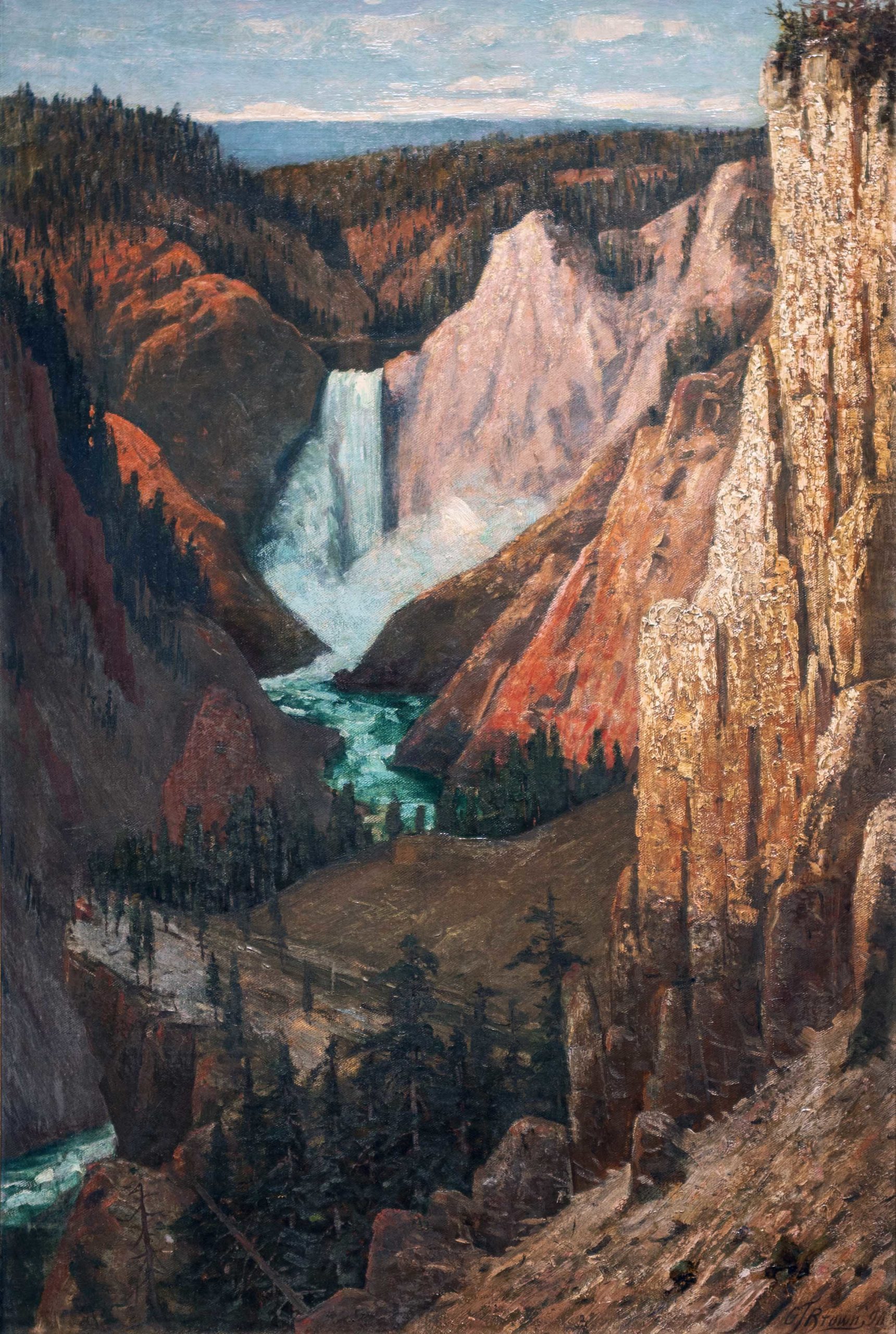
Grafton Tyler Brown, View of the Lower Falls, M Canyon of the Yellowstone, 1890, oil on canvas, 76.ix ten 51.2 cm (Smithsonian American Art Museum, photo: Steven Zucker, CC BY-NC-SA iv.0)

Theodore Roosevelt in Yellowstone National Park, c. 1903 ( NPS Photo)
In May of 1903, the twenty-sixth President of the The states, Theodore Roosevelt, fabricated a visit to the land of Arizona as a part of his Western tour across the country during the outset term of his presidency. He had come expressly to meet the G Coulee, a natural wonder not but detail to America, but to the earth 1 of the nation's crowning glories. In a spoken language delivered at the canyon on May 6, Roosevelt eloquently articulated what would become the defining mission statement of the conservation move in America throughout the twentieth century:
"In the M Canyon, Arizona has a natural wonder which, and then far as I know, is in kind absolutely unparalleled throughout the rest of the world. I want to ask you to practice one thing in connexion with it in your own involvement and in the interest of the state to go along this slap-up wonder of nature as it now is…Leave it as it is. You cannot improve on it. The ages have been at work on it, and homo can only mar it. What you can exercise is to continue it for your children, your children's children, and for all who come up after you, as ane of the great sights which every American, if he tin travel at all, should come across." (Theodore Roosevelt, Thousand Canyon Oral communication, May 6, 1903)
"Leave it every bit it is." A straightforward plea, only one that was intended to circumspection a society that had been zealous in its need for industrialization and Westward expansion throughout the nineteenth and twentieth century at the expense of dwindling natural resources.

Grafton Tyler Brown in his studio, c. 1880 (photograph: Smithsonian Institution Athenaeum)
The 1890 painting above of the falls of the Grand Canyon of the Yellowstone by Grafton Tyler Brown exemplifies the sentiment backside Roosevelt'southward impassioned speech fifty-fifty equally it depicts a different Grand Canyon, the i constitute at Yellowstone in Wyoming, non Arizona. Grafton Dark-brown, the first African American artist to pigment extensive scenes of the Due west and Pacific Northwest, understood implicitly that he was painting a view of a rare natural monument to preserve for posterity.
When Grafton Chocolate-brown came to Yellowstone National Park in Wyoming, the park was officially merely xviii years old (President Ulysses Grant had signed its condition into police on March ane, 1872). Brown had settled in Portland, Oregon in 1866 after a prolific career as a lithographer and cartographer in San Francisco in the 1860s, nearly a decade afterwards the heady days of the California golden blitz. In 1890, Dark-brown traveled to Yosemite and Yellowstone to paint its signature features, its geysers, mountains, canyons, and falls, for audiences who were hungry for the curiosities and wonders of the West.

Grafton Tyler Brown, Old True-blue Geyser, Yellowstone National Park, 1887, oil on canvas, 22 x 3″ / 55.9 ten 76.2 cm (Stark Museum of Art, Orange, Texas)

Tourists at the Grand Geyser, Yellowstone, c. 1912 (photo courtesy of the Library of Congress)
The opening of the Northern Pacific Railway in 1883, which linked the states of the Bully Lakes to the West towards Montana, facilitated a surge in tourism and travel to the newly appropriated National Parks. When Rudyard Kipling visited Yellowstone in 1889, he wrote in his journals that he encountered "The Wonderland" one has only read nigh in books. On gazing at the splendor of the falls at the Yellowstone's Grand Coulee, Kipling, recounted his awe:
"All I can say is without warning or grooming, I looked into a gulf i,700 feet deep with eagles and fish hawks circling far below. The sides of that gulf were one wild welter of color—crimson, emerald, cobalt, ochre, amber, honey splashed with port vino, snow white, vermillion, lemon, and silver greyness in wide washes. So far below that no sound of its strife could reach united states. Now I know what it is to sit enthroned amongst the clouds of dusk."
It is this view that Grafton Tyler Brown shows us in his 1890 painting of the falls. Brown focuses the central epitome at an upward right bending looking down towards the falls and the canyon so that the viewer experiences a sense of being engulfed in the upward rise of the carmine cliffs and the surging blueish spray. The grandeur and majesty described by Kipling is conveyed in Brown's paradigm through the careful play of nighttime and lite, as the sun spreads across the superlative half of the falls and coulee in a diagonal sweep roofing the pines and the bridge on the left in shadow. Though Brown's image of the falls emphasizes their dramatic beauty, it is different from the familiar paintings of the West'due south mountains and canyons by artists like Albert Bierstadt and Thomas Moran with their overt religious symbolism and securely scaled, dramatic use of lite.

Albert Bierstadt, Yosemite Valley, 1868, oil on sheet, 91.44 × 137.16 cm / 36 × 54″ (Oakland Museum of California)
Brown's background as a lithographer and cartographer inclined him towards rendering a more scientific, de-romanticized prototype of the Grand Canyon of the Yellowstone. The skills that Dark-brown had learned as a cartographer and draftsman in San Francisco in the 1860s gave him an belittling eye with which to describe and paint the Grand Canyon with precision and clarity free from religious or sentimental associations.

Grafton Tyler Brown, View of Yosemite Valley, 1886, oil on canvas, 29 3/4 x 17 1/ii″ / 75.half dozen x 44.v cm (Brooklyn Museum)
Throughout the late nineteenth century, there was palpable anxiety felt by many across America that the state's vast natural resources were being irrevocably diminished and destroyed as the nation industrialized and expanded Westward. The United States census of 1890 contended that with each passing year the development in the name of progress was "redeeming wilderness by the mitt of man."* As railroads stretched beyond the country, Native Americans were systemically driven from their homelands and forced onto reservations. The once vast bison herds were being hunted, forests cut for pasture, and the once arable passenger pigeon was driven to extinction. The bountiful American Eden seemed to be vanishing. It wouldn't exist until the belatedly nineteenth century with the pioneering efforts of conservationists like John Muir, George Bird Grinnell, and Theodore Roosevelt, that Americans would become concerned with safeguarding their land and wildlife.

Buffalo soldiers in the 24th Infantry conveying out patrol duties in Yosemite, c. 1899 (Yosemite Research Library)
Though Grafton Tyler Brownish was the first blackness painter to devote himself to depicting scenes of the Pacific Northwest and the West, the history of African Americans within the National Park system is a rich and varied ane. Betwixt 1891 and 1913, the soldiers of the 9th and 10th Cavalry and the 24th and 25th Infantry, the Buffalo Soldiers, were assigned with protecting Yosemite National Park and Sequoia National Park from poachers and timber thieves. Non merely did these start park rangers face the routine challenge of having to assert their authorisation against those who refused to recognize the protected status of the park'due south copse and wildlife, merely the added burden of racism—so owned at the time in mail service-Reconstruction era America—put the Buffalo Soldiers in a dangerous position.
Brown was frequently the subject field of commonplace racial prejudice in San Francisco during the 1860s, a somewhat bouncy coastal boom-town in the aftermath of the Aureate Rush that was filled with transplanted Southerners and Midwesterners. Due to his mixed race background, he was frequently referred to equally a "mulatto" or "quadroon," pregnant that he perchance had three Caucasian grandparents. Living and working in the W with its semi-lawless frontier towns and pockets of intolerance must have been a challenging and emotionally trying feel for a sensitive, educated Eastern-born son of a freedman, simply Brown's prolific trunk of work in the thirty years after he moved to San Francisco exemplify his remarkable talent and endurance every bit an creative person.

Grafton Tyler Brownish, Map of Virginia City, Nevada Territory, c. 1864, published past the C.C. Kuchel Company in San Francisco
By 1893, Dark-brown had settled in St. Paul, Minnesota where he began work as a cartographer and consultant with the U.Due south. Army Corps of Engineers and the urban center'south engineering department. He would remain in Minnesota until his death in 1918.
Grafton Tyler Brown'due south career showcases the astonishing efforts of an extraordinary, yet sadly, relatively ignored artist who persevered despite the racial intolerance of the late nineteenth century to forge a fascinating body of work that painstakingly documents the beauty of America'due south western landscapes.
* Every bit quoted by Dayton Duncan, "George Melendez Wright and the National Park Thought," National Park Service Centennial Essay Series
Additional resources:
Robert J. Chandler,San Francisco Lithographer: African American Artist Grafton Tyler Brown (University of Oklahoma Press, 2014).
Dreck Spurlock Wilson, ed.,African-American Architects: A Biographical Dictionary, 1865-1945(Routledge, 2004).
William Loren Katz,The Black West: A Documentary and Pictorial History of the African American Role in the Westward Expansion of the U.s.a. (Touchstone, 1996).
Source: https://smarthistory.org/brown-view-of-the-lower-falls-grand-canyon-of-the-yellowstone/
0 Response to "Joshua Johnson Produced the Art Work Grand Canyon of the Yellowstone at Hayden Point"
Post a Comment